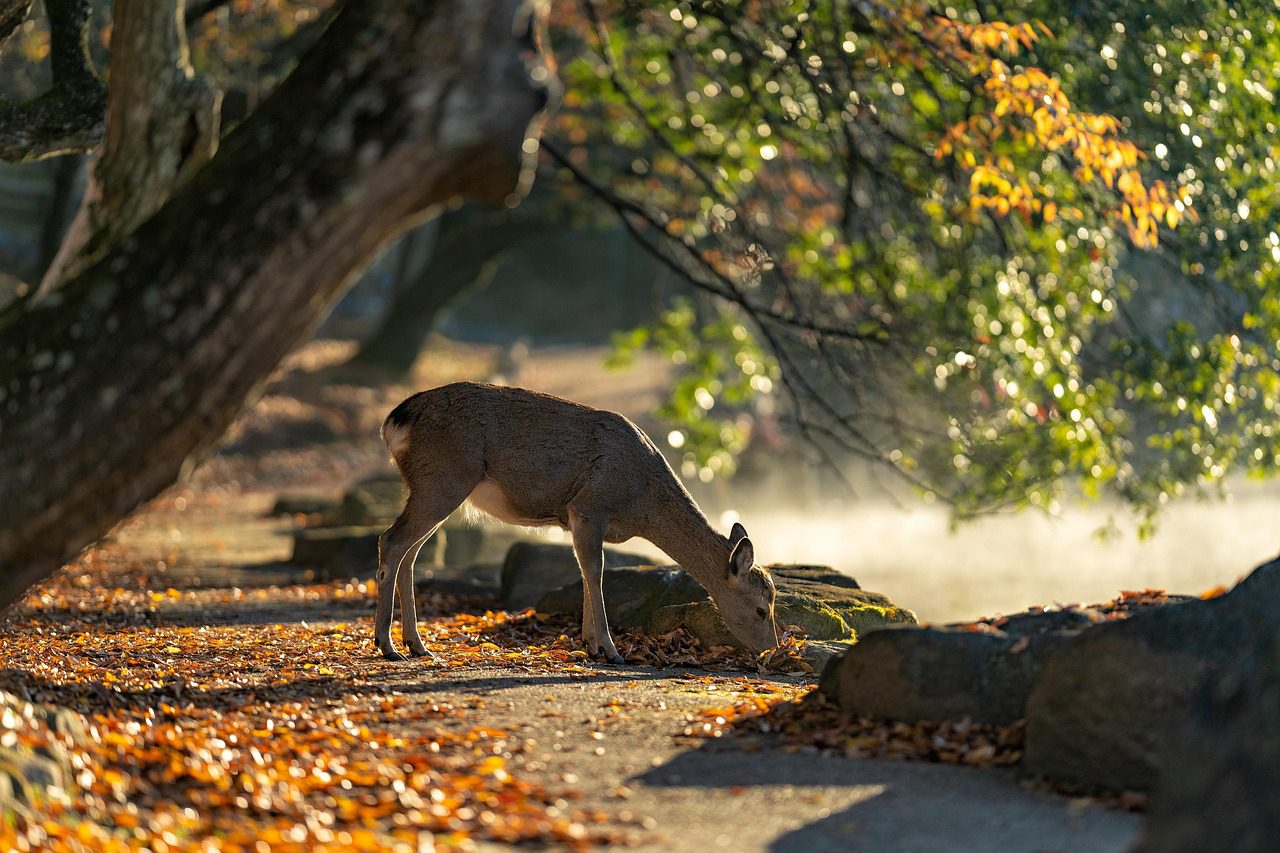
In the crisp air of a Japanese autumn, Nara Park transforms into a living tapestry of gold and rust. Among the swaying maples and whispering ginkgo trees, a solitary deer stands on a narrow gravel path, nibbling delicately at the foliage nestled between time-worn rocks. To a casual observer, it might appear as a simple, idyllic scene – yet for many in Japan, the deer of Nara embody something far more profound: the enduring coexistence of nature, spirituality, and urban life.
Legend has it that these deer are the descendants of messengers sent by the Shinto gods over a millennium ago. Revered and protected for centuries, they roam freely through the city, often approaching visitors with an audacious confidence born from divine privilege. The local community regards them not merely as animals but as living symbols of harmony – an unspoken reminder that reverence for the natural world is not a matter of nostalgia but of ethical responsibility.
Yet, the serenity of this coexistence has not gone unchallenged. As tourism has intensified, so too has the friction between human convenience and ecological preservation. Litter, noise, and inappropriate feeding practices threaten to erode the delicate balance that sustains these creatures. Conservationists warn that unless visitors learn to engage with the park respectfully, the deer’s trust, painstakingly cultivated over centuries, may vanish as swiftly as the autumn leaves themselves.
Still, in the gentle rustle of the leaves and the measured steps of the deer, there lingers a quiet wisdom. Perhaps the lesson Nara’s deer offer is not one of passive observation, but of mindful coexistence – a call to see the natural world not as a backdrop for human experience, but as a companion in our shared story of survival.

🌸 English Review Tasks
🦌 Advanced English Story – Deer – Advanced Practice (C1 Level)
A. Vocabulary Practice
1. Match the words to their meanings.
| Word | Meaning |
|---|---|
| a. coexistence | 1. A deep respect or admiration for someone or something |
| b. reverence | 2. The act of living or existing together peacefully |
| c. audacious | 3. To harm or reduce the strength or quality of something gradually |
| d. erode | 4. Bold, confident, or daring, sometimes in a surprising way |
| e. preservation | 5. The act of keeping something safe from damage or decay |
2. Choose the correct word to complete each sentence.
- The deer in Nara are seen as (sacred / ordinary / troublesome) animals.
- Many visitors act with little (reverence / curiosity / hesitation) toward the natural environment.
- The author warns that human carelessness can (restore / erode / multiply) the deer’s trust.
- The phrase “delicate balance” refers to the park’s fragile state of (peace / pollution / isolation).
- The deer’s calm behavior shows the possibility of (conflict / coexistence / competition) between humans and nature.
B. Grammar & Structure Practice
1. Complete the sentences with the correct form of the verb in brackets.
(Use the present perfect, past perfect, or passive voice where appropriate.)
- The deer __________ (protect) by local laws for centuries.
- Many visitors __________ (forget) the park’s spiritual significance.
- By the time conservationists intervened, the delicate balance __________ (begin) to deteriorate.
- The park’s reputation __________ (spread) around the world through tourism and media.
- Efforts to restore harmony __________ (make) by both locals and environmentalists.
2. Combine the ideas using advanced connectors (e.g. although, whereas, in spite of, provided that, unless).
Example: Tourists enjoy feeding the deer. It often harms their health. → Although tourists enjoy feeding the deer, it often harms their health.
- The deer are friendly. Some visitors still feel afraid.
- People admire the deer’s beauty. They sometimes forget to respect the park’s rules.
- The harmony between species can continue. Humans must behave responsibly.
- The park looks peaceful. It faces serious ecological challenges.
- The deer have lived beside humans for centuries. Their trust could still vanish.
C. Writing Practice
✏️ Short Response (150 – 180 words)
Question:
In the story, the deer symbolize harmony between humans and nature.
👉 Do you think modern cities can truly coexist with nature? Why or why not?
Use these words and expressions to help you:
coexistence, reverence, preservation, balance, urban life, harmony, responsibility, fragile, sustainable, spiritual.
🌿 Extension (Optional Creative Task)
Reflect:
If the deer of Nara could speak, what advice might they give to humans about living with nature?
Write a short paragraph (80 – 100 words) in the deer’s voice, using figurative language (metaphor, imagery, or personification).
How did you find this advanced English story? Check out the stories page for more!
Don’t forget to review grammar on our grammar page too.